If you're groggy for hours after waking, crash around 2pm and get a second wind at midnight, you likely have circadian rhythm disruption: your body clock is running on a different schedule from your life. The pattern of your symptoms points to which kind. The checklist below maps each daytime sign to its likely cause, so you fix the right problem first.
Key takeaways
- If you sleep fine but at the wrong times, the issue is timing, not insomnia.
- Outdoor light within 30 to 60 minutes of waking is the strongest everyday signal for shifting your clock earlier.
- Hold one wake time seven days a week and let bedtime follow it.
- Scrolling in a dark bedroom at dawn is a likely cause of drift, not only a symptom.
- Give habit changes four to six weeks before asking a sleep specialist about a circadian rhythm disorder.
In this guide
- What are the most common signs of circadian rhythm disruption?
- Is it a circadian issue or insomnia?
- What causes circadian rhythm disruption beyond shift work?
- Can a time change disrupt your circadian rhythm?
- How does it affect energy, mood and focus?
- Which daily habits reset a disrupted circadian rhythm?
- Do app blockers help when willpower is the problem?
- When should you see a sleep specialist?
- What does a realistic first week look like?
- FAQ
What are the most common signs of circadian rhythm disruption?
The core sign is a mismatch: you're sleepy when your schedule needs you awake and alert when it needs you asleep. The Sleep Foundation describes circadian rhythm sleep disorders as a misalignment between your internal clock and your environment, showing up as trouble falling asleep, staying asleep, or staying awake.
Night-time signs
You scroll in bed long past when you meant to stop, then can't fall asleep once you finally put the phone down. Sleep arrives late, so a 6:30 alarm feels brutal. On weekends with no alarm you sleep until late morning and feel fine, which is itself a clue that the timing, not your sleep quality, is the problem.
Daytime signs you feel at your desk
The crash comes in waves, mid-morning or mid-afternoon, rather than a steady fade. Focus drops, you reach for caffeine, and your mood sours for no obvious reason. You feel foggiest during hours your body still treats as night.
Is it a circadian issue or insomnia?
Insomnia means you can't sleep even when your schedule allows it. A circadian problem means you sleep reasonably well, just at the wrong times. If you fall asleep at 2am without a struggle and drag yourself up at 7am feeling jet-lagged, that's timing, not sleeplessness.
The 10-minute self-assessment
Answer yes or no to each question, then read the right-hand column for your yes answers.
| Question | A "yes" points to |
|---|---|
| Do you fall asleep easily, but 2+ hours later than you want? | Delayed body clock |
| Is your weekend sleep 2+ hours later than weekday sleep? | Social jet lag |
| Do you wake groggy even after 8 hours in bed? | Sleep window misaligned with your clock |
| Do you scroll in the dark before sunrise most mornings? | Light-timing problem |
| Do you feel most alert after 9pm? | Delayed body clock |
| Have you tried sleeping earlier and just lain awake? | Circadian timing, not insomnia |
What your pattern points to
Three or more yes answers suggest your sleep window has drifted, most likely later. That drift is common in people whose first bright light of the day comes from a phone screen in a dark bedroom. If only the scrolling question is a yes, your sleep may be on schedule and the fix is the first ten minutes after waking. Either way, shift light timing first and bedtime second.
What causes circadian rhythm disruption beyond shift work?
Shift work and jet lag are the textbook causes, but for most people on a normal schedule the bigger culprits are light at the wrong times and irregular wake times. Each one pushes the clock in the same direction: later.
Shift work and jet lag
Night shifts and flights across time zones force your clock to fight the daylight around you; the Sleep Foundation's overview of circadian rhythm sleep disorders covers both. If you work regular daytime hours, these probably aren't your problem.
The dark-bedroom scroll
The likelier cause: waking in a dark room and scrolling straight away. You get screen light at an hour your body expects darkness and no daylight at the hour it expects morning. That combination tells your clock the day starts later than it does, so you feel groggy at noon and wired at midnight.
Irregular schedules and late light
Weekend wake-ups three hours later than weekdays, caffeine after 2pm, and bright screens late at night all stretch the drift. Evening screen light can delay melatonin release, according to the Sleep Foundation. That's why one late weekend can undo a good week.
Can a time change disrupt your circadian rhythm?
Yes, for a few days. When the clocks change, your body clock doesn't change with them, so your sleep, appetite and alertness run an hour out of step with the clock on the wall. That short circadian disruption is what people call time change sickness: groggy mornings, trouble falling asleep at your usual hour and an off-kilter afternoon.
Why spring forward hits harder than fall back
Losing an hour in spring is the harder change. The American Academy of Sleep Medicine links the spring switch to daylight saving time with short-term rises in cardiovascular events, mood disorders and motor vehicle crashes, according to its 2020 position statement. A study of US fatal crashes from 1996 to 2017 found about 6% more in the week after the spring change, and no overall change in the fall week (Fritz et al., 2020).
How to adjust after the clocks change
Treat the new time as real from the first morning. Get up at your usual time on the new clock and get outdoor light soon after waking: bright morning light is the strongest everyday signal for setting your clock earlier (Khalsa et al., 2003). Keep evenings dim, keep caffeine early, and hold the same wake time through the weekend.
After the clocks fall back in November, sunrise lands an hour earlier on the clock, which makes it a good week to start a morning light habit. Dawnova times your light window to each day's local sunrise, so your plan moves with the clocks automatically.
How does it affect energy, mood and focus?
A late-running clock produces two signature symptoms: the afternoon crash and the midnight second wind. Your internal "morning" arrives hours after your alarm, so early hours feel foggy and the afternoon dip hits hard. The same delay pushes your evening alert phase toward midnight, which is why you feel oddly awake scrolling at 1am.
Low mood and poor focus before noon trace to the same delay. Your brain is still in its night phase while you're halfway through your workday. Fixing the timing, not just the total hours, is what lifts both.
Which daily habits reset a disrupted circadian rhythm?
Four habits do most of the work: morning light before your phone, a fixed wake time, dimmer evenings, and making the morning scroll hard to reach. Start with light, because it's the main signal your body clock uses to set itself.
Get morning light before you touch your phone
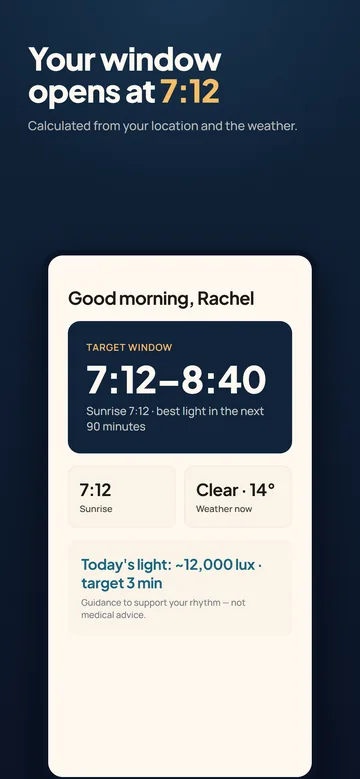
Aim for outdoor light within 30 to 60 minutes of waking. Light timing matters more than duration: in a controlled study, bright light given in the biological morning shifted the clock earlier, while light in the evening shifted it later (Khalsa et al., 2003). Ten to fifteen minutes outside on an overcast day still beats sitting by a window, because indoor light is far dimmer than daylight.
Fix your wake time, not your bedtime
A fixed wake time anchors the whole rhythm. Pick one and hold it seven days a week, then let bedtime fall where it falls for the first two weeks. Bedtime usually follows the wake time; forcing an early bedtime rarely works.
Dim the evenings
Use lamps instead of overhead lights after dark, and turn screen brightness down in the last hour before bed. A few rounds of 4-7-8 breathing make a good last step. You don't need perfection, just less light at night than you got in the morning. Our morning and night routine guide pairs each evening step with the morning habit it sets up.
Make the morning scroll hard to reach
The first 30 minutes awake are exactly when the habit fires, in a dark room, training your clock the wrong way every day. Charge the phone outside the bedroom, or use a blocker that only unlocks after you've been outside, so the habit you need and the unlock become the same action.
Do app blockers help when willpower is the problem?
They help if the block is hard to undo half-asleep. Two features matter most: how hard the block is to lift from bed, and whether lifting it requires something physical. Opal, ScreenZen, one sec and Clearspace add delays or pauses but stay undoable from bed; Brick needs a tap on a separate device.
Dawnova (our app) takes a different approach: its Morning Focus feature keeps chosen apps blocked until you walk 15 steps and snap a photo of the morning sky, then times a short outdoor light session to sunrise and weather. The unlock is the habit you're trying to build. If you've beaten Apple's limits before, our guide on how to bypass Screen Time shows how to close those gaps too.
Built for dark mornings too. Dawnova scales the session to today's real daylight, about 3 minutes in bright sun and 10 on a grey winter morning. With no usable daylight, a lamp session or movement check unlocks instead; for the darkest months, see our guide to choosing a light therapy lamp.
When should you see a sleep specialist?
Give the habits four to six weeks. If you've held a steady wake time, got morning light and cut evening screens, and you still can't fall asleep before 2 or 3am, you may have delayed sleep phase disorder rather than a scrolling habit. If your sleep time drifts later every day despite a fixed schedule, ask about non-24-hour sleep-wake disorder.
What a specialist actually does
A sleep specialist can diagnose the specific disorder rather than guess. Options can include timed light therapy, carefully timed melatonin (timing matters more than dose), and other treatments for less common conditions. Ask for a circadian rhythm evaluation specifically, since general insomnia advice often misses these.
What does a realistic first week look like?
Change one thing: get outside within 30 minutes of waking, before touching any app. Expect days one and two to feel easy because it's new, days three to five to feel irritating, and the pull of the morning scroll to start fading toward the end of the week.
Days 1 to 3
Put the phone across the room and step outside for about ten minutes after waking. If mornings are where your willpower runs out, let a blocker hold the line so the decision isn't yours at 6am.
Days 4 to 7
This is the rough patch. The old habit pulls hardest, and staring at a locked screen is annoying. That friction is the point. If you miss a day, restart the next morning rather than abandoning the routine; earlier sleepiness at night tends to follow once mornings are consistent.
Frequently asked questions
How do I know if my circadian rhythm is disrupted?
Look for groggy mornings after a full night in bed, mid-afternoon crashes, low mood before noon, and a second wind after 9pm. If sleeping late on weekends makes you feel normal, your clock has likely shifted later. Three or more yes answers on the checklist above point the same way.
Can doomscrolling in bed mess up my circadian rhythm?
It can, in two ways. Scrolling in a dark room at dawn gives you screen light when your body expects darkness and no daylight when it expects morning. Scrolling late at night adds evening light that can delay melatonin. Both push your clock later.
How long does it take to reset a disrupted circadian rhythm?
Expect a rough patch around days three to five and noticeable change after a week or two of consistent morning light and a fixed wake time. Give the full set of habits four to six weeks before deciding whether to see a sleep specialist.
Do app blockers work if I always find a way around them?
Blockers that only add a delay stay easy to undo from bed. Look for ones that need something physical to unlock: Brick needs a tap on a separate device, and Dawnova needs a few steps and an outdoor light session. For the strongest effect, pair either with the phone charging outside the bedroom.
Is it a circadian problem or insomnia if I can't fall asleep before 2am?
If you fall asleep at 2am without a struggle and only feel wrecked because of an early alarm, that's a timing issue. If you try to sleep earlier and lie awake, that also points to circadian timing. Insomnia means you can't sleep even when your schedule allows it.
Sources
- Sleep Foundation, Circadian Rhythm Sleep Disorders: Types and Treatments.
- Sleep Foundation, Delayed Sleep Phase Disorder.
- Sleep Foundation, How Does Blue Light From Electronic Devices Affect Sleep?
- Khalsa, Jewett, Cajochen & Czeisler (2003). A phase response curve to single bright light pulses in human subjects. The Journal of Physiology, 549(3).
- Rishi et al. (2020). Daylight saving time: an American Academy of Sleep Medicine position statement. Journal of Clinical Sleep Medicine, 16(10).
- Fritz, VoPham, Wright & Vetter (2020). A chronobiological evaluation of the acute effects of daylight saving time on traffic accident risk. Current Biology, 30(4).
This article is general information, not medical advice. Dawnova is a wellness tool, not a medical device. If you have ongoing sleep problems, bipolar disorder or an eye condition, talk to a clinician before using bright-light routines.
Written by the Dawnova team. We build Dawnova, a morning light and routine app, and base its guidance on published circadian research. This article isn't medical advice. Questions or corrections? Get in touch.