4-7-8 breathing for sleep means inhaling through your nose for 4 counts, holding for 7, and exhaling through your mouth for 8, repeated four times. It slows your breathing and lengthens the exhale, which lowers heart rate and helps your body shift into rest mode. Used as a nightly wind-down cue, it can make falling asleep easier.
Key takeaways
- One round is inhale 4, hold 7, exhale 8; do four rounds, about one minute in total.
- The ratio matters more than the speed; count faster if the hold feels hard.
- In a small 2022 study, 4-7-8 breathing lowered heart rate and systolic blood pressure after one session.
- It works best as a nightly cue: the same one-minute routine each night tells your body the day is over.
- It works best as part of a wind-down that also takes the phone out of your hand.
In this guide
- What is 4-7-8 breathing?
- How do you do 4-7-8 breathing step by step?
- How does 4-7-8 breathing help you sleep?
- Why would a long exhale help you relax?
- When should you do it for sleep?
- What if you feel light-headed at first?
- How does it compare with box breathing?
- How do you make it a nightly habit?
- FAQ
What is 4-7-8 breathing?
4-7-8 breathing is a slow-breathing pattern popularized by integrative medicine physician Dr. Andrew Weil, adapted from yogic breath control (pranayama). Each round is a 4-count inhale through the nose, a 7-count breath hold, and an 8-count exhale through the mouth. The exhale is twice as long as the inhale, which is the part that does most of the work.
How do you do 4-7-8 breathing step by step?
Sit up or lie on your back, and keep the tip of your tongue on the ridge just behind your upper front teeth throughout. One full session is four rounds and takes about a minute. The instructions below follow the version described by Weil and by Cleveland Clinic.
- Empty your lungs. Exhale completely through your mouth, making a soft whoosh sound.
- Inhale for 4. Close your mouth and breathe in quietly through your nose while counting to four.
- Hold for 7. Hold your breath for a count of seven. Don't strain.
- Exhale for 8. Breathe out through your mouth, around your tongue, with a whoosh, for a count of eight.
- Repeat three more times for four rounds in total, then breathe normally.
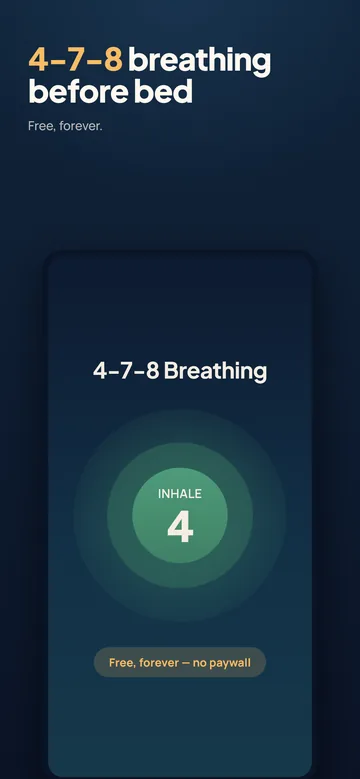
Keep the 4:7:8 ratio, not a particular speed. If holding for seven feels like a struggle, count faster; Cleveland Clinic's Melissa Young, MD, says you can adjust the pace to your comfort while the ratio stays the same. Start with four rounds; more isn't better at first.
How does 4-7-8 breathing help you sleep?
It helps your body relax, and a relaxed body falls asleep more easily. In a 2022 study, a single session lowered heart rate and blood pressure, and reviews of slow breathing link it to calmer, "rest and digest" nervous-system activity. With nightly practice, the routine itself becomes a signal that it's time to sleep.
| Evidence | What it found | Why it matters for sleep |
|---|---|---|
| Vierra et al., 2022 | 43 young adults did 3 sets of 6 rounds; heart rate and systolic blood pressure fell after one session, both in short and normal sleepers | A slower heart and lower blood pressure are the state you fall asleep in |
| Zaccaro et al., 2018 (review) | Slow breathing in general was linked to more parasympathetic ("rest and digest") activity and less anxiety | Explains why the long exhale is the key ingredient |
| Cleveland Clinic | Recommends practicing twice a day, at set times | Regular practice turns it into a habit you can rely on |
So 4-7-8 is a free, one-minute way to shift your body toward sleep, especially when a racing mind or a restless body is what keeps you up. It pairs well with morning daylight, which sets when you feel sleepy in the first place (see our explainer on circadian rhythm disruption).
Why would a long exhale help you relax?
Breathing out slowly favors the parasympathetic side of your nervous system, the branch that slows the heart. Heart rate naturally rises a little as you inhale and falls as you exhale, so a long exhale spends more time in the slowing phase. Counting also gives an anxious mind one simple job.
That's why the exhale-to-inhale ratio matters more than the hold. If breath holds bother you, slow breathing with a long exhale and no hold, such as inhaling for 4 and exhaling for 6 to 8, gets you most of the same effect.
When should you do it for sleep?
Use 4-7-8 breathing for sleep twice: once as part of your wind-down 30 to 60 minutes before bed, and again in bed with the lights off. The first session signals the end of the day; the second gives a busy mind something to do instead of replaying it. It also works if you wake at 3am and can't settle.
Do it with the phone out of reach. Four rounds of breathing followed by twenty minutes of scrolling cancels the point; the screen's light and stimulation keep you alert. Our morning and night routine guide shows how to set up the last hour so the phone isn't there to grab.
What if you feel light-headed at first?
A little light-headedness is common in the first few sessions, Cleveland Clinic notes, because you're changing your usual breathing rhythm. Count a bit faster or do fewer rounds, and it settles as you get used to it. If the hold feels uncomfortable, keep the long exhale and skip the hold. If you have a heart or lung condition or are pregnant, check with your clinician before practicing breath holds.
How does it compare with box breathing?
Both slow your breathing; they differ in rhythm. Box breathing uses four equal sides, so it's steadier and easier during the day. 4-7-8's long exhale makes it the more sleep-oriented of the two. Pick the one you'll actually do every night.
| Technique | Pattern | Best for |
|---|---|---|
| 4-7-8 breathing | Inhale 4 · hold 7 · exhale 8 | Bedtime and middle-of-the-night wake-ups |
| Box breathing | Inhale 4 · hold 4 · exhale 4 · hold 4 | Daytime stress, focus before a task |
| Extended exhale | Inhale 4 · exhale 6 to 8, no hold | Anyone who dislikes breath holds |
How do you make it a nightly habit?
Attach it to something that already happens every night, and make it the gate between the evening and bed. The technique only helps if you do it, and most people forget by the third night unless something prompts them.
That's what Dawnova (our app) does with Evening Wind-Down. The apps you choose pause 30, 60 or 90 minutes before your bedtime and stay paused until you finish one guided breathing session, with 4-7-8, box breathing and an evening reset to choose from. Skip it and they stay paused until midnight. The breathing becomes the way the evening ends instead of another scroll.
Why it sticks. A guided pacer keeps the counts steady so you can close your eyes and follow along, and tying it to your apps means the routine happens every night, not just on the nights you remember. When the session ends, put the phone down and let the calm carry you to sleep.
If late-night scrolling is the bigger problem, our guide to a dopamine detox for phone addiction covers a 7-day plan for the hours your phone wins most.
Frequently asked questions
How many times should you do 4-7-8 breathing?
Four rounds per session, which takes about a minute; that's the total in Weil's own instructions. Cleveland Clinic's Melissa Young, MD, suggests practicing twice a day so it becomes automatic. If you're still awake after a session, rest a few minutes with normal breathing before trying again.
How fast does 4-7-8 breathing work?
The calming effect starts right away: in a 2022 study, one session lowered heart rate and blood pressure. Some people drift off within minutes, and it gets easier as the routine becomes familiar, so practice it every night rather than saving it for bad nights.
Why do I feel light-headed doing 4-7-8 breathing?
It's common in the first few sessions because you're changing your usual rhythm. Breathe normally for a moment, then count a little faster or do fewer rounds; it usually settles as you get used to it. If it persists, or you have a heart or lung condition, check with a clinician.
Is 4-7-8 breathing better than box breathing for sleep?
For bedtime, 4-7-8's long exhale makes it the more calming choice for many people, while box breathing suits daytime stress. The best technique is the one you'll practice every night.
Should I do 4-7-8 breathing in bed or before bed?
Both work. A session 30 to 60 minutes before bed marks the end of the day; another in bed with the lights off gives a busy mind something to focus on. Keep your phone out of reach either way, or the scrolling afterwards undoes the calm.
Is the 4 7 8 sleep method the same as 4-7-8 breathing?
Yes. The 4 7 8 sleep method, 478 breathing and the 4-7-8 breathing method are all names for the same technique: breathe in through your nose for a count of 4, hold for 7, then breathe out through your mouth for 8, for four rounds. The counts are a ratio, so count faster if the hold feels long.
Sources
- Vierra, Boonla & Prasertsri (2022). Effects of sleep deprivation and 4-7-8 breathing control on heart rate variability, blood pressure, blood glucose, and endothelial function in healthy young adults. Physiological Reports, 10(13).
- Zaccaro et al. (2018). How Breath-Control Can Change Your Life: A Systematic Review on Psycho-Physiological Correlates of Slow Breathing. Frontiers in Human Neuroscience, 12.
- Cleveland Clinic, 4-7-8 Breathing Method for Sleep and Relaxation.
- Andrew Weil, MD, Breathing Exercises: 4-7-8 Breath.
General information, not medical advice. If you have a heart or lung condition or are pregnant, check with a clinician before practicing breath holds.
Written by the Dawnova team. We build Dawnova, whose Evening Wind-Down uses guided 4-7-8 and box breathing, and we cite the research we rely on. This article isn't medical advice. Questions or corrections? Get in touch.