A morning and night routine works best as one 24-hour loop: every evening anchor exists to make a matching morning anchor automatic. Charge your phone outside the bedroom at night, and the first hour of tomorrow has no scroll within reach. This guide pairs each night habit with the morning habit it feeds, so you stop doomscrolling in the dark without leaning on willpower.
Key takeaways
- Design your evening routine to set up your morning routine; treat them as one loop.
- Charging your phone outside the bedroom is the one anchor that does the most work.
- Build every step on places and objects, not motivation, which disappears after a bad night.
- Morning daylight before the first scroll does double duty: it ends the scroll and sets your body clock.
- Track time-to-first-scroll, lights-off consistency and wake mood instead of streaks.
In this guide
- Why design your night routine around your morning?
- Which evening anchors make waking up easier?
- How do you build a morning routine that survives a bad night?
- How should you sequence the last hour and the first hour?
- What's the minimum viable morning and night routine?
- How do you stop the morning scroll if you bypass every blocker?
- How do you keep the loop when travel breaks it?
- How do you know the loop is working after two weeks?
- FAQ
Why design your night routine around your morning?
Your evening and morning are one cycle, and light shows it most clearly. Evening light pushes your body clock later, while morning light pulls it earlier, which shifts when you feel sleepy tonight and how groggy you feel tomorrow, as the Sleep Foundation explains. A night routine that dims screens is really a morning routine in disguise.
So build the loop backwards. Pick each evening anchor because it makes one morning behavior happen without a decision: the phone charging out of reach tonight means no doomscroll in bed at dawn.
Why willpower routines collapse by week two
Checklist routines fail because every step asks for a decision, and decisions need energy you don't have at 6am in the dark. The fix is to remove decisions, not to try harder. Each anchor below replaces a choice with a place or an object.
Which evening anchors make waking up easier?
Four evening anchors do the work your morning willpower can't. Each one forces a specific morning behavior to happen automatically, before you're awake enough to argue with yourself.
| Evening anchor | Morning behavior it makes automatic |
|---|---|
| Phone charges outside the bedroom | No scrolling in bed; you get up to reach it |
| Fixed lights-off time | A steadier wake time without an alarm battle |
| Tomorrow's first action decided | No idle scrolling while you figure out what's next |
| Wind-down trigger | Lights-off on cue, not at 1am |
Anchor 1: the phone charges out of arm's reach
Dock your phone in the kitchen or hallway. The scroll you'd do in bed now requires standing up and walking, and that friction is the whole trick. If the phone is your alarm, a $10 alarm clock replaces it.
Anchor 2: a fixed lights-off time beats a fixed bedtime
"Bedtime" drifts; switching the light off is a physical action you can tie to something you already do. A consistent lights-off time is what steadies your wake time, and a steady wake time is what makes mornings stop feeling like a fight.
Anchor 3: decide tomorrow's first action tonight
Pick your first waking action now: shower, coffee, a walk to the corner. Write it on a note by the door. Without a decision, the default first action is reaching for the phone.
Anchor 4: a wind-down trigger that replaces the scroll
Evening scrolling fills a slot, so give that slot something else: a shower, stretching, a paper book, a few rounds of 4-7-8 breathing. When the trigger fires, the phone goes on its dock. The Sleep Foundation's bedtime routine guide lists more options.
How do you build a morning routine that survives a bad night?
Design for your worst morning, not your best. A routine that only works after eight good hours is a good day, not a routine. Every core step should run on an anchor (a place, an object, a light source) because a five-hour night removes exactly the motivation you'd otherwise rely on.
Picture a short-sleep morning: heavy, groggy, no interest in anything optional. Getting daylight and drinking water survive that state. Journaling and a 20-minute workout usually don't, so save them for rested days. Light matters most because morning daylight is the strongest cue your body clock uses, and a rough night is exactly what knocks that clock off.
The 2-item fallback
Define two things you'll do even at your worst: get outside within a few minutes of waking, and keep the phone out of reach until you have. Hit those two and the loop survived the day.
How should you sequence the last hour and the first hour?
The last hour before bed is a setup job, and the first hour after waking cashes it in. Each evening step removes one morning decision. Here is the paired timeline.
| Time | Step | What it sets up |
|---|---|---|
| Bed −60 min | Phone docks across the house | No scroll in bed tonight or at dawn |
| Bed −30 min | Overhead lights off, lamps only | A clear dark signal before sleep |
| Lights off | Same time every night, ±30 min | A steady wake time |
| Wake +0 | Get up to switch off the alarm | You're already standing |
| Wake +5 to 30 min | Outside for daylight, even if grey | Body clock anchored for tonight |
| After light | Coffee, breakfast, then phone | The scroll starts after the day does |
Outdoor light, even on an overcast morning, is far brighter than a bedroom ceiling light, which is why stepping outside beats sitting by a lamp. If you need more on dark winter mornings, our guide to choosing a light therapy lamp covers the gap.
What's the minimum viable morning and night routine?
Three anchors and about ten minutes of effort. At night, the phone charges outside arm's reach at a set time. In the morning, step outside for a few minutes of daylight. Then scroll, seated, somewhere other than bed. Each anchor makes the next one automatic.
If you keep only one, keep the phone out of the bedroom. A widely cited study found that the mere presence of your own smartphone reduced available working memory, even when it was face down (Ward et al., 2017). Distance is easier than resisting.
What to add after two weeks
If the scroll keeps winning in the middle of the day too, our dopamine detox for phone addiction guide lays out a 7-day plan.
Once the three-anchor loop holds for 14 days, add one thing: a fixed wake time on weekends too, or one line in a journal. One at a time. If the addition breaks the loop, drop it.
How do you stop the morning scroll if you bypass every blocker?
Any blocker you can undo from bed loses at 6am. You know the password, you know the workaround, and the phone is in your hand before you're fully awake. At that hour, the missing piece isn't willpower; it's friction you can't remove lying down. Our guide on how to bypass Screen Time lists every hole and how to close it.
Dawnova (our app) flips the order. Its Morning Focus feature keeps the apps you choose blocked after your alarm until you walk 15 steps and snap a photo of the sky, then times an outdoor light session to your local sunrise and weather. The unlock is getting up and getting to the light, which is also the cue your body clock wants.
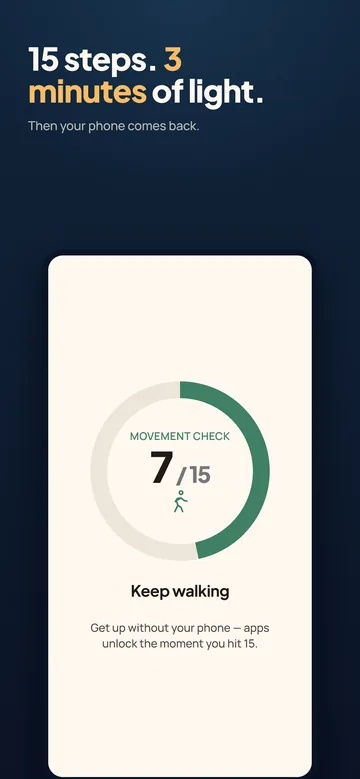
Built for real mornings. The light session adapts to your local sunrise and the weather, about 3 minutes in bright sun and 10 on a grey winter day. When there's no usable daylight, a lamp session or movement check unlocks instead, so the loop keeps running in December. Evening Wind-Down covers the other end of the day by pausing the same apps before bed until you finish one guided breathing session.
How do you keep the loop when travel breaks it?
Shrink the anchors instead of skipping them. At night, the phone still charges out of reach, wherever you are. In the morning, the daylight step scales to the setting: a walk to get coffee, or five minutes by a bright hotel window when going out isn't practical. Same order, smaller size.
The one-anchor rule for disrupted weeks
During a chaotic week, protect exactly one anchor: no phone until after daylight. Everything else can flex. If your blocker allows a passcode override, you'll use it at 6am in a dark room, so an override that needs you on your feet holds better than one that needs a code (Apple's Screen Time passcode can be reset with an Apple Account password). One protected anchor keeps the loop alive until your schedule settles.
How do you know the loop is working after two weeks?
Feelings are unreliable after two weeks; three numbers logged daily are not. Track time-to-first-scroll, lights-off consistency and wake mood, and read them together.
- Time-to-first-scroll: minutes between your alarm and opening a social app. If the loop is holding, this drifts from under 2 minutes toward 15 or more.
- Lights-off consistency: when the light actually went out. Within 30 minutes of your target on five nights a week means the evening anchors are working.
- Wake mood: a 1 to 5 rating within five minutes of waking, before you touch anything. Better sleep often shows up here first.
If time-to-first-scroll stalls while lights-off improves, the night side works and the morning blocker needs tightening. If both stall, the loop broke upstream, usually in the last hour before bed.
Frequently asked questions
How long does it take to break the habit of scrolling in bed?
Plan on about two weeks of consistent anchors before the loop feels automatic. The phone-out-of-the-bedroom anchor does most of the work: if the phone isn't within reach, the habit can't fire. Watch time-to-first-scroll; when it moves from under two minutes to 15 or more, the old pattern is breaking.
What is a good morning and night routine for someone who hates mornings?
Keep three anchors: the phone charges outside arm's reach at a set time, lights go off at a fixed time, and you get a few minutes of outdoor daylight after waking. That's under ten minutes of effort. Coffee comes after the light, not before.
Is it bad to check your phone right after waking up?
The bigger problem is what it replaces. Scrolling in bed takes the place of the morning light that anchors your body clock, and it hands your first decision of the day to a feed. Get a few minutes of daylight first, then check your phone sitting somewhere else.
How do I stop scrolling TikTok in the dark before I get out of bed?
Take the phone out of the bedroom. Charge it in the kitchen or hallway and use a cheap alarm clock. Switching off the alarm then means standing up and walking, which is enough friction to end the in-bed scroll for most people.
Can an app blocker work if I always find a way around it?
Passcode blockers fail because the override is one tap away in a dark room. Blockers that tie the unlock to an action, like walking outside, change the cost: getting around them means getting out of bed. Pair it with the phone charging out of reach and the in-bed scroll has nowhere to start.
Sources
- Sleep Foundation, Light and Sleep.
- Sleep Foundation, How to Build a Better Bedtime Routine for Adults.
- Ward, Duke, Gneezy & Bos (2017). Brain Drain: The Mere Presence of One's Own Smartphone Reduces Available Cognitive Capacity. Journal of the Association for Consumer Research, 2(2).
- Apple Support, Change your Screen Time passcode on an iPhone or iPad.
Dawnova is a wellness tool, not a medical device. If you have ongoing sleep problems, bipolar disorder or an eye condition, talk to a clinician before using bright-light routines.
Written by the Dawnova team. We build Dawnova, a morning routine app that blocks distracting apps until you've been outside, and we run this loop ourselves. Questions or corrections? Get in touch.