A dopamine detox for phone addiction works when you aim it at the habit. The idea is built on proven habit science: cut the cues that trigger scrolling, put friction in front of the apps, and replace the habit with something you value. Aim it at the first hour after waking and the last hour before bed, where the habit fires most.
Key takeaways
- The "detox" name is a metaphor; what changes is your habit, and that's the part that lasts.
- The original method is a cognitive behavioral approach: fewer triggers, planned breaks, better replacements.
- In a three-week experiment, capping social apps at 10 minutes each per day reduced loneliness and depression.
- Short, targeted breaks beat all-day abstinence that you abandon by Wednesday.
- Morning and bedtime are the highest-value windows to protect.
In this guide
- What is a dopamine detox, really?
- What does a dopamine detox actually change?
- Is phone addiction a real addiction?
- What does research say about cutting back?
- How do you do a dopamine detox for your phone in 7 days?
- Which hours of the day matter most?
- What should you do instead of scrolling?
- When is it more than a bad habit?
- FAQ
What is a dopamine detox, really?
A dopamine detox, or dopamine fast, is a planned break from quick-reward activities like social feeds, games and notifications. California psychiatrist Cameron Sepah designed it as a cognitive behavioral therapy technique: you reduce exposure to triggers so compulsive habits lose their grip, according to Harvard Health.
The internet version drifted a long way from that. Social posts describe days without music, conversation or even eye contact. Sepah's version was smaller and practical: a few hours each evening, one weekend day, and the occasional longer break, aimed at whichever behavior is causing you distress.
What does a dopamine detox actually change?
Your habits. Dopamine is part of how the brain learns which rewards to chase, and a detox works by changing what happens around the urge, as Harvard Health's Peter Grinspoon explains. Sepah himself called the name a catchy title. That's good news: a habit is something you can start changing this week.
Setting that goal is what makes it stick. Instead of waiting for a "reset", you change the cues around the urge so it fires less often and wins less often. Each day of the plan below does exactly that.
Is phone addiction a real addiction?
"Phone addiction" isn't a formal diagnosis. Researchers usually call it problematic smartphone use: checking you can't control, that crowds out sleep, work or relationships, and that leaves you feeling worse. You don't need a diagnosis for the pattern to be worth changing.
Emily Hemendinger, a psychiatry professor at the University of Colorado Anschutz, notes that many people scroll "not to feel good and happy but just to feel normal" (CU Anschutz). That's the compulsive loop a detox targets: the phone relieves a small discomfort, so you reach for it the next time the discomfort shows up.
What does research say about cutting back?
Controlled studies of reducing social media, rather than quitting it entirely, show real benefits. Two are worth knowing, along with one on the phone itself.
| Study | What people did | What changed |
|---|---|---|
| Hunt et al., 2018 | 143 students limited Facebook, Instagram and Snapchat to 10 minutes per app per day for 3 weeks | Lower loneliness and depression than the unrestricted group |
| Allcott et al., 2020 | Adults deactivated Facebook for 4 weeks | Higher well-being; they kept using it less even after reactivating |
| Ward et al., 2017 | Phone on the desk vs in another room during tests | Better working-memory scores with the phone in another room |
The pattern: limiting works, and the benefits build over weeks of steady change. That's why the plan below is a week long and focused rather than one dramatic day.
How do you do a dopamine detox for your phone in 7 days?
Spend the first two days measuring, the next three removing cues and adding friction, and the last two protecting the hours that matter most. Each day adds one change, so nothing depends on a burst of willpower.
| Day | Change | Why |
|---|---|---|
| 1 | Check your screen time report; note your top 3 apps and when you open them | You can't target a habit you haven't located |
| 2 | Write down what you felt right before each pickup: bored, anxious, avoiding a task | The trigger, not the app, is what you're changing |
| 3 | Turn off every non-human notification | Removes the cues that start the loop |
| 4 | Move the top 3 apps off your home screen, or log out of them | Adds seconds of friction to each open |
| 5 | Charge the phone outside the bedroom | Ends the in-bed scroll at both ends of the day |
| 6 | Block the top 3 apps for your first hour awake | The morning scroll sets the tone for the day |
| 7 | Block them again for the last hour before bed, and compare your report with Day 1 | Late scrolling costs sleep, which feeds the next day's cravings |
Then keep what worked and drop what didn't. If you've already tried this with Apple's limits and talked yourself past them, our guide on how to bypass Screen Time shows how to close those gaps.
Which hours of the day matter most?
The first hour after waking and the last hour before bed. In the morning, the scroll replaces the daylight that sets your body clock and hands your first decision to a feed. At night, it pushes sleep later, and short sleep makes the next day's urges harder to resist. Protect those two hours and the middle of the day often follows.
That's the approach behind Dawnova (our app). Morning Focus keeps the apps you choose blocked after your alarm until you walk 15 steps and snap a photo of the sky, then times a short outdoor light session. Evening Wind-Down pauses them again 30, 60 or 90 minutes before bed until you complete one guided breathing session; skip it and they stay paused until midnight.
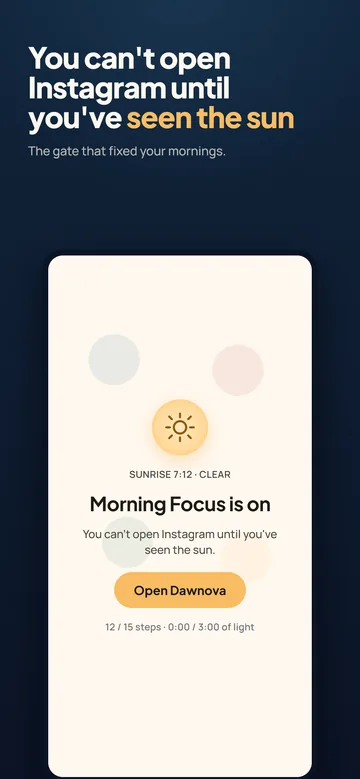
Why two windows work. Protecting the first and last hour gives you a daily break without giving up your phone. The morning unlock gets you outside into daylight, and the evening one ends your day with a minute of slow breathing, two habits that support better sleep. Pair it with days 1 and 2 of the plan above and you're working on both the trigger and the habit.
Our morning and night routine guide covers how to build both windows around anchors instead of willpower.
What should you do instead of scrolling?
Pick a replacement that fits the same slot and the same feeling. Hemendinger recommends "replacing it with more valued or healthy behaviors," which is the core of the original method. A blank gap fills itself with the phone again; a planned activity doesn't.
- Bored in a queue: a paper book or a podcast you chose earlier, not a feed.
- Anxious before a task: a two-minute walk or a written first step.
- Groggy after waking: step outside for daylight; it also anchors your body clock.
- Wired at bedtime: a few rounds of slow breathing; our guide to 4-7-8 breathing for sleep walks through one.
Expect discomfort for the first few days. Hemendinger compares suppressed feelings to a beach ball held underwater: stop scrolling and they pop back up. That's normal, and it passes.
When is it more than a bad habit?
If phone use is hurting your sleep, work, school or relationships and cutting back doesn't hold for more than a few days, talk to a doctor or therapist. Constant scrolling can be a way of coping with anxiety or low mood, and treating the underlying problem works better than any blocker. If you're in crisis, contact local emergency services or a crisis line.
Frequently asked questions
Does a dopamine detox actually work for phone addiction?
Yes, when you treat it as habit change. Reducing triggers, adding friction and replacing the habit are standard cognitive behavioral techniques, and controlled studies show that limiting social media use improves mood over a few weeks. The name is a metaphor; the results come from the habit change.
How long should a dopamine detox last?
Start small and repeatable rather than long. Harvard Health suggests the originator's version: a few hours at the end of each day, one weekend day, and occasional longer breaks. A daily one-hour window you keep beats a 24-hour fast you quit after one try.
What should I avoid during a dopamine detox?
Only the behaviors causing you problems, usually social feeds, short video, games or news. You don't need to avoid music, food, exercise or people. Cutting healthy activities is the extreme version Harvard Health criticizes, and it makes the break harder to sustain.
Can an app help with a dopamine detox?
Yes, if it adds friction you can't undo in a second. Screen Time and app blockers can schedule blocks; some, like Dawnova, tie the unlock to an action such as walking outside. For the best results, pair it with turning off notifications and charging the phone outside the bedroom.
Is phone addiction a mental illness?
It isn't a formal diagnosis. Researchers describe problematic smartphone use: compulsive checking that crowds out sleep, work or relationships. If it's causing real harm, or it's tied to anxiety or low mood, a doctor or therapist can help with the underlying cause.
Sources
- Grinspoon, P. (2020). Dopamine fasting: Misunderstanding science spawns a maladaptive fad. Harvard Health Publishing.
- Melani, D. (2024). Does a 'Dopamine Detox' Really Work? University of Colorado Anschutz.
- Hunt, Marx, Lipson & Young (2018). No More FOMO: Limiting Social Media Decreases Loneliness and Depression. Journal of Social and Clinical Psychology, 37(10).
- Allcott, Braghieri, Eichmeyer & Gentzkow (2020). The Welfare Effects of Social Media. American Economic Review, 110(3).
- Ward, Duke, Gneezy & Bos (2017). Brain Drain: The Mere Presence of One's Own Smartphone Reduces Available Cognitive Capacity. Journal of the Association for Consumer Research, 2(2).
This article is general information, not medical advice. Dawnova is a wellness tool, not a medical device.

Written by the Dawnova team. We build Dawnova, a morning routine app that blocks distracting apps until you've been outside, and we cite the research we rely on. Questions or corrections? Get in touch.