A light therapy lamp can replace morning sunlight on the days you can't get outside, such as dark winter mornings before sunrise. A 10,000 lux lamp used for 20 to 30 minutes within an hour of waking is the standard setup. Outdoor daylight is usually stronger and quicker, from at least 5,000 lux under cloud to 100,000 in sun, so a lamp works best as your plan B.
Key takeaways
- The standard morning light therapy setup is about 10,000 lux for 20 to 30 minutes within an hour of waking.
- Daylight ranges from at least 5,000 lux under cloud to about 100,000 lux in direct sun.
- Daylight is also more effective at stimulating the eye's clock-setting cells than electric light of the same brightness.
- A lamp is the best option before sunrise, in the far north, or when you can't get outside.
- Choose a UV-filtered lamp and use it at the distance the maker specifies.
In this guide
Can a light therapy lamp replace morning sunlight?
On the mornings you can't get outside, yes. A light therapy lamp gives your eyes a bright, steady dose of light at breakfast, which is the signal your body clock needs to know the day has started. It is the standard indoor option when daylight isn't available, recommended by the Mayo Clinic for dark seasons.
Think of it as a very good plan B. When the sun is up, a few minutes outside usually gives you more light in less time. When it isn't, a lamp keeps your routine on track.
Why morning light matters in the first place
Light in your biological morning moves your body clock earlier, so you feel sleepy at a sensible hour and wake more easily; light late in the evening does the opposite (Khalsa et al., 2003). A lamp and the sky both deliver that morning signal. They just differ in strength and convenience.
How does a 10,000 lux lamp compare with daylight?
A good lamp delivers about 10,000 lux at its rated distance. Outside, daylight is at least 5,000 lux under an overcast sky and can reach 100,000 lux in direct sun, according to the Open University. So a lamp sits between a grey sky and a sunny one.
| Light source | Typical brightness at your eyes | Usual morning time |
|---|---|---|
| Window-lit room | About 200 to 300 lux | Not enough on its own |
| Light therapy lamp | About 10,000 lux at the rated distance | 20 to 30 minutes |
| Overcast sky outdoors | At least 5,000 lux | About 10 minutes |
| Direct sun outdoors | Up to about 100,000 lux | A few minutes |
Brightness isn't the whole story
Daylight has an extra edge. A 2022 expert consensus in PLOS Biology notes that electric light is less effective at stimulating the eye's clock-setting cells than daylight of the same brightness. That is one reason lamp sessions run longer than outdoor ones, and why the sky remains the first choice whenever it's available.
When is a lamp the better choice?
A lamp wins whenever real daylight isn't there when you need it. The most common case is winter, when sunrise comes after your alarm and your day is underway before it gets light. In the far north that can last for months.
- Before sunrise. If you're up and out of the door in the dark, a lamp at breakfast gives you morning light on schedule.
- Very dark winter days. Heavy cloud late in the year can keep the outdoor dose low; a lamp tops it up.
- Early shifts and odd schedules. A lamp lets you choose when your "morning" light happens.
- No safe or easy way outside. Illness, mobility limits or a newborn at home all make a lamp the practical option.
The "morning light therapy" routine
Used this way, a lamp is a habit tool as much as a gadget. Put it where you already sit each morning, such as the breakfast table or desk, so the session happens alongside coffee or email rather than as an extra task.
How do you use a light therapy lamp in the morning?
Use it within the first hour after waking, for about 20 to 30 minutes, with the lamp roughly 16 to 24 inches from your face and your eyes open. That is the setup the Mayo Clinic describes for a 10,000 lux light box.
- Place it slightly to the side and above eye level. The light should reach your eyes without you staring into it.
- Keep the rated distance. 10,000 lux applies at the distance the maker specifies; further away, the light drops quickly.
- Keep your eyes open and carry on. Read, eat breakfast or work while it's on.
- Use it in the morning, not at night. Evening sessions can push your clock later.
- Start gently if you're new to it. Shorter sessions for the first few days are a comfortable way in.
Talk to a clinician first if you have an eye condition or bipolar disorder; the Mayo Clinic notes that increasing light exposure too quickly can trigger manic symptoms in people with bipolar disorder.
Should you combine a lamp with going outside?
Yes, and it's the easiest way to keep a year-round habit. Use the sky whenever it's up and the lamp when it isn't. On a dark winter morning, a lamp at breakfast followed by a short walk after sunrise gives you the best of both.
Dawnova is built around that mix. On most days, its Morning Focus keeps chosen apps blocked until you walk 15 steps and snap a quick photo of the sky, and a light session timed to sunrise and cloud cover counts as your day's light. In Winter Mode, when outside light is too low or the sun isn't up yet, a photo of your lamp unlocks instead and a lamp session counts toward your streak.
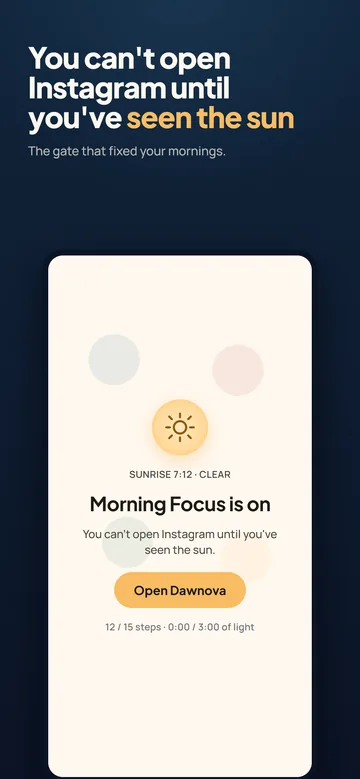
Built for every season. Dawnova follows the real sky over your street: short sessions in sun, longer ones under cloud, and a lamp on the darkest mornings. That way your routine survives winter instead of stopping in November. For overcast days, see our guide to morning sunlight on cloudy days.
What should you look for in a lamp?
Look for 10,000 lux at a comfortable working distance, a large light-emitting surface, and UV filtering. Light boxes for this purpose should filter out most or all UV light, according to the Mayo Clinic. A size you'll actually leave on the table matters more than extra features.
Quick checklist
- 10,000 lux, with the distance stated by the maker.
- UV-filtered, diffuse white light.
- A panel big enough to sit in front of without leaning in.
- A spot at your breakfast table or desk where it can stay plugged in.
Our full guide to choosing a light therapy lamp has picks and more detail. If you're dealing with groggy mornings and late nights, our circadian rhythm disruption checklist helps you work out whether light timing is the cause.
Frequently asked questions
Is a light therapy lamp as good as sunlight?
On days you can't get outside, it's the best substitute. A 10,000 lux lamp gives a strong morning signal, but outdoor daylight is often brighter and is more effective per lux at stimulating the eye's clock-setting cells. Use the sky when it is up and the lamp when it isn't.
How long should I sit in front of a 10,000 lux lamp?
About 20 to 30 minutes within the first hour after waking is the standard routine, with the lamp around 16 to 24 inches from your face. Keep the distance the maker specifies, because brightness falls quickly as you move away.
Can I use a light therapy lamp at night?
It's best kept for the morning. Bright light in the evening can push your body clock later, which makes it harder to fall asleep. If you need light for activities at night, keep it dim and warm.
Is a sunrise alarm clock the same as a light therapy lamp?
No. A sunrise alarm brightens gradually to wake you gently; it is not built to deliver 10,000 lux at your eyes the way a light therapy lamp is. It can make waking easier, then a lamp or a few minutes outside gives you the bright morning light.
Does Dawnova work with a light therapy lamp?
Yes. In Winter Mode, when outdoor light is too low or the sun isn't up yet, a photo of your lamp unlocks Morning Focus and a lamp session counts toward your daily light, so dark months keep your streak going.
Sources
- Mayo Clinic, Seasonal affective disorder treatment: Choosing a light box.
- The Open University, Energy in buildings: daylight and illuminance (OpenLearn).
- Brown, Brainard, Cajochen et al. (2022). Recommendations for daytime, evening, and nighttime indoor light exposure to best support physiology, sleep, and wakefulness in healthy adults. PLOS Biology, 20(3).
- Khalsa, Jewett, Cajochen & Czeisler (2003). A phase response curve to single bright light pulses in human subjects. The Journal of Physiology, 549(3).
This article is general information, not medical advice. Dawnova is a wellness tool, not a medical device. If you have ongoing sleep problems, bipolar disorder or an eye condition, talk to a clinician before using bright-light routines.

Written by the Dawnova team. We build Dawnova, a morning light and routine app, and base its guidance on published circadian research. This article isn't medical advice. Questions or corrections? Get in touch.