Yes. Morning sunlight on cloudy days still counts, because an overcast sky is far brighter than it looks. Daylight under cloud is at least 5,000 lux, while a typical window-lit office gets 200 to 300 lux. That gap is why a grey morning outside still tells your body clock the day has started. You just need a few more minutes than on a sunny day.
Key takeaways
- Overcast daylight is at least 5,000 lux; full sun can reach 100,000 lux.
- Rooms lit by windows typically get 200 to 300 lux, so even a grey sky outside is roughly 20 times brighter.
- Morning light shifts the body clock earlier, and that works on cloudy days too.
- Plan on about 10 minutes outside under thick cloud, compared with a few minutes in bright sun.
- Sitting by a window is a weak substitute; step outside, even onto a balcony or doorstep.
In this guide
- Does morning sunlight on a cloudy day still count?
- How bright is a cloudy morning compared with indoors?
- How long should you stay outside when it is overcast?
- Does morning sunlight through a window work?
- What about rain, fog and dark winter mornings?
- How do you keep the habit going when it is grey?
- FAQ
Does morning sunlight on a cloudy day still count?
It does. Your body clock responds to how much light reaches your eyes, and an overcast morning outdoors still delivers far more of it than any room in your home. Clouds lower the brightness from "dazzling" to "plenty", which is still enough to signal morning. In a controlled study, bright light in the biological morning moved the clock earlier (Khalsa et al., 2003).
What changes on a grey day is the dose. Bright sun does the job in a few minutes; thick cloud needs longer. The habit itself, going outside soon after waking, is the same in every kind of weather.
Why cloud fools your eyes
Your eyes adapt quickly, so a dull sky and a bright living room can feel similar after a minute. A light meter tells a different story. The difference you can't see is the one your body clock responds to, which is why "it looks dark out" is a poor guide to whether a morning walk is worth it.
How bright is a cloudy morning compared with indoors?
Much brighter. Daylight under an overcast sky is at least 5,000 lux, according to the Open University, and direct sun can reach 100,000 lux. The same source puts a typical window-lit office at 200 to 300 lux for most of the day.
| Where you are | Typical light level |
|---|---|
| Window-lit office or living room | About 200 to 300 lux |
| Outside under an overcast sky | At least 5,000 lux |
| Outside in direct sun | Up to about 100,000 lux |
Sleep researchers have noticed the same gap. A 2022 expert consensus in PLOS Biology notes that indoor lighting guidelines usually sit at least ten times below natural outdoor light, and that electric light is less effective at stimulating the eye's clock-setting cells than daylight of the same brightness.
What that means for your morning
Ten minutes on the doorstep on a grey day gives you more light than hours at a desk near the window. People who spend most of the day indoors also run later body clocks: in a camping study, a week of natural light only pulled participants' clocks into line with sunrise and sunset (Wright et al., 2013).
How long should you stay outside when it is overcast?
Plan on about 10 minutes under thick cloud and a few minutes in bright sun, ideally within an hour of waking. Brighter light reaches the same effect sooner, so the time you need goes up as the sky gets darker. Consistency matters more than precision: a daily ten minutes beats an occasional hour.
- Go out soon after waking. Morning light is what moves your clock earlier; the same light late in the evening pushes it later (Khalsa et al., 2003).
- Face the open sky. You don't need to look at the sun, and you shouldn't. Look around normally with the brightest part of the sky in your field of view.
- Skip the sunglasses if it's safe to. They cut the light you came out for. Regular glasses and contact lenses are fine.
- Add a few minutes when it's very dark. Heavy cloud, early winter mornings and narrow streets all lower the dose.
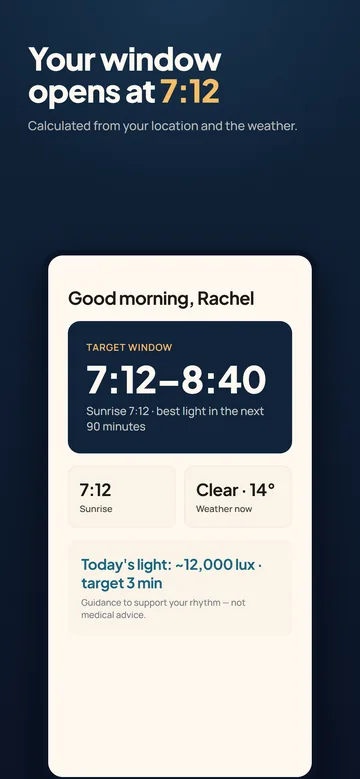
Letting the weather set the timer
Dawnova takes the guesswork out of it. It checks your local sunrise and today's cloud cover, then sets a light session to match: about 3 minutes in bright sun and around 10 on a grey winter morning. On a cloudy day you simply get a longer timer, so you never have to work out the maths yourself.
Does morning sunlight through a window work?
Only weakly. Indoors by a window you are getting a slice of the sky, filtered through glass and walls, which is why window-lit rooms sit around 200 to 300 lux while the street outside under cloud is at least 5,000. If you can open the door and step out, that one step gives you many times more light.
When indoors is your only option
If you can't go out, sit as close to the glass as possible with the window open, facing the sky rather than the room. A balcony, a porch or an open garage door all count as outside. On the darkest winter mornings, a light therapy lamp is the indoor option that comes closest; our guide on whether a lamp can replace morning sunlight covers when it makes sense.
What about rain, fog and dark winter mornings?
Rain and fog lower the light but rarely remove it. Stand under a porch roof, an umbrella or a bus shelter and you still get daylight from the open sky around you. Winter is the real challenge, because sunrise may come after you need to be up.
Mornings before sunrise
If it's still dark when you wake, get outside as soon as it's light, even if that's on the way to work. A walk to the station after sunrise counts. On days when there's no usable daylight before your morning starts, a 10,000 lux lamp at breakfast is the practical stand-in; see our guide to choosing a light therapy lamp.
How do you keep the habit going when it is grey?
Make going outside the default rather than a decision. Grey mornings are exactly when skipping feels reasonable, so the habit needs a trigger that doesn't depend on the weather. Tie it to something you do anyway: the first coffee on the doorstep, the dog walk, or the walk to the car.
Another approach is to make your phone wait for the light. Dawnova's Morning Focus keeps the apps you choose blocked in the morning; 15 steps and a quick photo of the sky unlock them, and a light session timed to sunrise and cloud cover counts as your day's light. Your morning scroll ends up outside, which is where the light is. Our morning and night routine guide shows how to pair it with an evening wind-down.
Built for grey mornings. Dawnova adjusts every session to the real sky over your street: shorter in sun, longer under cloud. In Winter Mode, when there's no usable daylight, a lamp session counts instead, so dark months never break your streak. If you're noticing signs of circadian rhythm disruption, consistent morning light is the place to start.
Frequently asked questions
Is overcast morning light enough to reset my body clock?
For most people, yes. Overcast daylight is at least 5,000 lux, many times brighter than a typical home or office. That is enough to signal morning to your body clock, especially when you get it within an hour of waking and repeat it daily. Spend a little longer outside than you would on a sunny day.
How long should I be outside on a cloudy morning?
About 10 minutes is a good target under thick cloud, compared with a few minutes in bright sun. Getting it soon after waking and doing it every day matters more than the exact number. If the sky is very dark or it is early winter, add a few more minutes.
Does morning light through a window count?
It helps a little, but much less than going outside. Window-lit rooms usually sit around 200 to 300 lux, while an overcast street is at least 5,000 lux. Open the window, sit right next to it facing the sky, or better, step onto a balcony or doorstep.
Do I need to look at the sun?
No, and you shouldn't. Light reaches your eyes from the whole sky, so just be outside and look around normally. Avoid staring at the sun on clear days, and skip sunglasses during your morning light time if it is comfortable and safe to do so.
What if it is still dark when I wake up?
Get outside once it is light, even if that is on your commute. On mornings with no usable daylight before your day starts, a 10,000 lux light therapy lamp at breakfast is the usual indoor option. Dawnova's Winter Mode counts a lamp session on those days.
Sources
- The Open University, Energy in buildings: daylight and illuminance (OpenLearn).
- Brown, Brainard, Cajochen et al. (2022). Recommendations for daytime, evening, and nighttime indoor light exposure to best support physiology, sleep, and wakefulness in healthy adults. PLOS Biology, 20(3).
- Khalsa, Jewett, Cajochen & Czeisler (2003). A phase response curve to single bright light pulses in human subjects. The Journal of Physiology, 549(3).
- Wright, McHill, Birks et al. (2013). Entrainment of the human circadian clock to the natural light-dark cycle. Current Biology, 23(16).
- Sleep Foundation, Light and Sleep.
This article is general information, not medical advice. Dawnova is a wellness tool, not a medical device. If you have ongoing sleep problems, bipolar disorder or an eye condition, talk to a clinician before using bright-light routines.

Written by the Dawnova team. We build Dawnova, a morning light and routine app, and base its guidance on published circadian research. This article isn't medical advice. Questions or corrections? Get in touch.