Revenge bedtime procrastination is staying up later than you meant to, with no outside reason, to win back free time a busy day didn’t give you. It usually looks like one more episode or another 40 minutes of scrolling. The fix isn’t more willpower at midnight. It’s giving that free time a protected slot earlier in the evening and an ending you don’t have to decide on.
Key takeaways
- Researchers define bedtime procrastination as going to bed later than intended when nothing external stops you (Kroese and colleagues, 2014).
- In a representative sample of 2,431 Dutch adults, bedtime procrastination linked lower self-regulation to feeling short on sleep.
- People who resisted more desires during the day were more likely to procrastinate on bedtime that night.
- It’s a habit pattern, not a diagnosis, and it isn’t the same as insomnia: you could fall asleep, you just don’t go to bed.
- The most reliable fixes move the “me time” earlier and make the end of the evening automatic.
In this guide
What is revenge bedtime procrastination?
Revenge bedtime procrastination is delaying sleep to get leisure time you feel you were owed, knowing you’ll be tired tomorrow. Psychologists at Utrecht University first described bedtime procrastination in 2014 as failing to go to bed at the intended time when no external circumstances prevent it. The “revenge” part came later, from social media.
The English phrase spread around 2020 as a translation of the Chinese expression 报复性熬夜 (roughly “retaliatory staying up late”), which described workers with long days taking their evenings back at the cost of sleep. The BBC’s 2020 explainer traces how the term took off during the pandemic. The research term is simply bedtime procrastination; the “revenge” label describes the motive.
How is it different from insomnia or being a night owl?
The difference is choice. With insomnia, you’re in bed and can’t fall asleep. With revenge bedtime procrastination, you could sleep but don’t go to bed. Being a night owl is about when your body clock wants sleep; procrastination is about staying up past the bedtime you set yourself.
The Sleep Foundation describes three features that mark it out: the delay cuts your total sleep, there’s no valid reason for it (no night shift, no crying baby), and you know at the time that you’ll pay for it. Night owls can procrastinate too, and the Sleep Foundation notes that people with an evening chronotype may be more prone to it, but the two are separate things. If you lie awake for long stretches most nights, that’s a different problem, and a conversation with a doctor is the right next step.
Why do people stay up late on purpose?
People stay up late on purpose because the evening is the first time all day nobody needs anything from them, and by then they have the least self-control left to stop. Research links bedtime procrastination to tiring days, heavy workloads and lower self-regulation, and the phone makes staying up very easy.
- A taxing day. In a study of 218 adults, Kamphorst and colleagues (2018) found that people who had resisted more desires during the day were more likely to go to bed later than intended.
- Lower self-regulation. In a representative sample of 2,431 Dutch adults, Kroese and colleagues (2016) found bedtime procrastination explained the link between self-regulation and feeling you don’t get enough sleep.
- Too many roles. A 2026 study of 393 US military servicemembers found those reporting heavier role overload also reported more revenge bedtime procrastination.
- No natural ending. Feeds and autoplay never finish. A book has a last chapter; a feed doesn’t, so the stopping point becomes a decision you keep putting off.
A 3-question self-check
Answer three questions about the last week. If you say yes to all three on most nights, the pattern fits revenge bedtime procrastination, and the cause table below points to the fix most likely to help. This is a habit check, not a diagnosis.
- Did you get into bed later than you planned, with nothing stopping you from going earlier?
- Was the time spent on something you chose for yourself (scrolling, shows, games) rather than chores or work?
- Did you know while you were doing it that you’d feel worse tomorrow?
| If the reason sounds like… | The likely driver | Start with |
|---|---|---|
| “It’s the only time that’s mine.” | No free time in the day | A protected hour before wind-down (step 1) |
| “I’m too tired to stop.” | End-of-day depletion | Decide the ending in advance (steps 2 and 4) |
| “Just one more video.” | Endless feeds | Swap to something with an ending (step 3) |
| “I don’t feel sleepy at 11.” | Late body clock | Morning daylight and a steady wake time (step 6) |
| “Tomorrow’s stressful, I don’t want it to come.” | Dread | A 5-minute to-do list at bedtime (step 5) |
How do you stop revenge bedtime procrastination?
Stop revenge bedtime procrastination by keeping the reward and moving it. Give yourself a protected block of free time earlier in the evening, decide the ending before you start, and let something other than tired, 11:45pm you call time. These six steps take about a week to set up.
1. Schedule the “revenge” before wind-down
The urge is real: you want time that belongs to you. So book it. Block 45 to 60 minutes after dinner that’s only for you, no chores, no work messages. When the evening already had a turn for you, there’s less to reclaim at midnight.
2. Pick your bedtime by counting back from your alarm
The American Academy of Sleep Medicine and Sleep Research Society recommend that adults sleep 7 or more hours a night on a regular basis. Count back 7.5 to 8 hours from your alarm to set an in-bed time, then set a phone or clock reminder 60 minutes before it. That reminder is your cue to start winding down.
3. Choose evening fun that ends
A film, one episode with autoplay off, a chapter, a game with levels, a call with a friend: they all have a natural stop. Feeds don’t. Turn off autoplay in your streaming apps, and save the endless scroll for daytime.
4. Make the cut-off automatic
At 11:45pm you won’t choose to stop, so don’t ask yourself to. Set the decision earlier: Downtime in Screen Time on iPhone, or Bedtime mode in Digital Wellbeing on Android, on a schedule. An app-blocking wind-down that pauses your scrolling apps an hour before bed works the same way, and charging the phone outside the bedroom closes the in-bed loophole.
5. Write tomorrow’s to-do list
If dread is part of it, park tomorrow on paper. In a 2018 sleep-lab study of 57 young adults, those who spent 5 minutes writing a specific to-do list at bedtime fell asleep faster than those who wrote about tasks they had already done.
6. Keep your wake time steady and get morning light
A late body clock makes 11pm feel like 9pm. Getting up at the same time every day and getting outside soon after waking gives your clock a strong morning signal; our post on circadian rhythm disruption symptoms explains why. A good night starts in the morning.
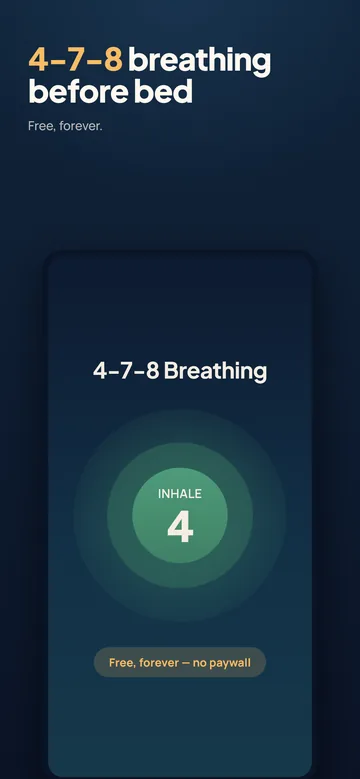
This is the idea behind Evening Wind-Down in Dawnova (our app). From 30, 60 or 90 minutes before your bedtime, the apps you pick are paused. One guided breathing session, such as 4-7-8 breathing, opens them again for the night, so the evening still belongs to you but now it has a deliberate pause in it. The Evening Wind-Down help article covers setup, and it’s part of Dawnova Pro (see plans).
Why it sticks. Revenge bedtime procrastination is a fight between “I want my time” and “I need sleep.” A wind-down that asks for two minutes of slow breathing doesn’t take the evening away. It gives the decision back to you at a moment when you’re calmer, and most nights that’s enough to put the phone down.
What should you do with your reclaimed evening?
Use the protected hour for things that feel like rest and have an end: a hobby, a walk, a long shower, a call, reading, cooking something you enjoy. The test is simple. If you’d be happy to stop when the hour is up, it’s a good pick. If it pulls you past bedtime, keep it for the weekend.
For the last 30 to 60 minutes before bed, the Sleep Foundation’s bedtime routine guide suggests putting electronics away and choosing calm activities such as reading, gentle stretching, a warm bath or breathing exercises. Our guide on how to stop using your phone before bed lists swaps for everything the phone does at night.
How much sleep are you trading away?
More than it feels like. Forty-five extra minutes a night is over five hours across a working week, close to a full night’s sleep. Adults need 7 or more hours on a regular basis, according to the AASM and Sleep Research Society consensus statement, and bedtime procrastination is linked to feeling short on sleep in the research above.
Late screens add a second cost. In a 2015 sleep-lab study at Brigham and Women’s Hospital, people who read on a light-emitting device before bed took longer to fall asleep, released less melatonin and felt less alert the next morning than when they read a printed book. That’s one reason a wind-down without screens is a good place to spend the last stretch of the evening.
If the scrolling is the main event, our posts on how to stop doomscrolling and the dopamine detox for phone addiction go deeper on the habit itself.
Frequently asked questions
Is revenge bedtime procrastination a sleep disorder?
No. It isn’t a clinical diagnosis. Researchers treat bedtime procrastination as a self-regulation pattern: going to bed later than you intended when nothing external stops you. If you can’t fall asleep once you’re in bed, or you feel very sleepy in the day despite enough time in bed, talk to a doctor.
Why is it called “revenge” bedtime procrastination?
The phrase comes from a Chinese expression about “retaliatory staying up late.” It describes taking revenge on a day that left no free time by staying up to get some back. The English version spread on social media around 2020, when many people’s work and home time blurred together.
Who is most likely to do it?
Research is still early. The Sleep Foundation notes that one study found students and women were more likely to report it, and that night owls and people who procrastinate in other areas may be more prone. People with long days and many roles, such as parents and shift-heavy jobs, also describe it often.
How do I stop staying up late on my phone?
Decide the ending before the evening starts. Schedule Downtime or Bedtime mode, charge the phone outside the bedroom, and use a wind-down that pauses your scrolling apps an hour before bed. Give yourself a protected block of free time earlier in the evening so there’s less to reclaim at midnight.
Can a consistent wake time help?
Yes. Getting up at the same time every day, and getting daylight soon after, keeps your body clock from drifting later. When you feel sleepy at a sensible hour, stopping is far easier. A late bedtime and a late wake-up tend to feed each other, so start with the morning end.
Sources
- Kroese FM, De Ridder DTD, Evers C, Adriaanse MA. Bedtime procrastination: introducing a new area of procrastination. Frontiers in Psychology, 2014.
- Kroese FM, Evers C, Adriaanse MA, de Ridder DTD. Bedtime procrastination: a self-regulation perspective on sleep insufficiency in the general population. Journal of Health Psychology, 2016.
- Kamphorst BA, Nauts S, De Ridder DTD, Anderson JH. Too depleted to turn in: the relevance of end-of-the-day resource depletion for reducing bedtime procrastination. Frontiers in Psychology, 2018.
- Barrow TR, Cooper CR, Revell L, et al. The characterization of revenge bedtime procrastination in military servicemembers. Military Medicine, 2026.
- Watson NF, et al. Recommended amount of sleep for a healthy adult: a joint consensus statement of the AASM and Sleep Research Society. Journal of Clinical Sleep Medicine, 2015.
- Scullin MK, Krueger ML, Ballard HK, et al. The effects of bedtime writing on difficulty falling asleep. Journal of Experimental Psychology: General, 2018.
- Chang AM, Aeschbach D, Duffy JF, Czeisler CA. Evening use of light-emitting eReaders negatively affects sleep, circadian timing, and next-morning alertness. PNAS, 2015.
- Sleep Foundation, Revenge Bedtime Procrastination.
- BBC Worklife, The psychology behind “revenge bedtime procrastination”, November 2020.
This article is general information, not medical advice. Dawnova is a wellness tool, not a medical device. If you have ongoing sleep problems, bipolar disorder or an eye condition, talk to a clinician before using bright-light routines.
Written by the Dawnova team. We build Dawnova, an app blocker with an Evening Wind-Down that pauses your scrolling apps before bed until one guided breathing session. Research checked in November 2026. Spotted something out of date? Tell us.