The simplest answer to how to stop using your phone before bed is to stop needing it there. Replace its night jobs (alarm, white noise, reading, “what time is it?”), set a wind-down time about an hour before sleep, and charge it outside the bedroom. Then fill the last hour with things that end, such as a book, a shower or slow breathing.
Key takeaways
- In a survey of 844 adults, six in ten took their phone to the bedroom, and bedtime phone use was linked to worse sleep quality and more daytime fatigue.
- In a sleep-lab study, reading on a light-emitting device before bed meant taking longer to fall asleep and feeling less alert the next morning than reading a printed book.
- The Sleep Foundation suggests putting electronics away at the start of a 30-to-60-minute bedtime routine.
- The no-phone-in-the-bedroom rule only holds once the phone’s alarm, sound and reading jobs have another home.
- Writing a specific to-do list for 5 minutes at bedtime helped people fall asleep faster in a 2018 study.
In this guide
Why is it so hard to put your phone down at night?
It’s hard to put your phone down at night because the phone has no natural stopping point and you’re at your most tired. Feeds refill, videos autoplay, and by 11pm the part of you that plans is running low. Stopping becomes a decision you have to make again every few minutes.
Researchers who study revenge bedtime procrastination find the same pattern: people who had a more demanding day are more likely to go to bed later than they meant to. So the plan below doesn’t lean on late-night willpower. It moves the decisions to earlier in the evening, when they’re easy.
What does phone use before bed do to your sleep?
Phone use before bed is linked to taking longer to fall asleep, lighter sleep and more tiredness the next day. Two things seem to drive it: the screen’s light late in the evening, and content that keeps your mind busy. Studies show associations and lab effects rather than one simple cause, but they point the same way.
- In adults’ bedrooms. In a survey of 844 Flemish adults, Exelmans and Van den Bulck (2016) found six in ten took their phone to the bedroom. Texting or calling after lights out predicted worse sleep quality scores, and bedtime phone use predicted later rise times and more fatigue.
- In the sleep lab. In a 2015 study published in PNAS, people who read on a light-emitting device in the hours before bed took longer to fall asleep, made less melatonin, had a later body clock and were less alert the next morning than when they read a printed book.
- On evening light. A 2022 expert consensus in PLOS Biology recommends keeping light at the eye low (a melanopic EDI of 10 lux or less) for at least 3 hours before bedtime.
Content matters as much as light. The Sleep Foundation notes that stimulating content such as social media, games or work email makes it harder to relax, and it suggests removing electronic devices from the bedroom altogether.
How to stop using your phone before bed in 7 steps
Set this up once, on a weekend, and the evening runs itself. The steps below move every phone decision to earlier in the day. Times assume an 11pm bedtime; shift them to match yours.
- Pick a bedtime that fits your alarm. Adults need 7 or more hours of sleep on a regular basis, per the AASM and Sleep Research Society. Count back from your wake time and write the bedtime down.
- Set a wind-down time an hour earlier. At 10pm a reminder or schedule starts the routine. On iPhone, a Sleep schedule in the Health app with Wind Down turns on the Sleep Focus; on Android, Bedtime mode in Digital Wellbeing can mute notifications and turn the screen grayscale.
- Pause the apps that keep you up. Downtime in Screen Time or app timers in Digital Wellbeing can lock social and video apps from 10pm. If you know the passcode, consider a blocker that asks for an action instead. Our guide to setting app limits on iPhone and Android has the exact steps.
- Turn off autoplay. Streaming and video apps let you switch off autoplay of the next episode. One episode then ends on its own.
- Do tomorrow’s admin at 9:45pm, not in bed. Check the weather, reply to the last message, set the alarm clock. Nothing left to look up later.
- Plug the phone in outside the bedroom. Hallway, kitchen or living room. This is the step that does most of the work, so the next section covers how to make it stick.
- Start a screen-free last hour. Lights down, then something from the list further down: a book, a shower, stretching, slow breathing.
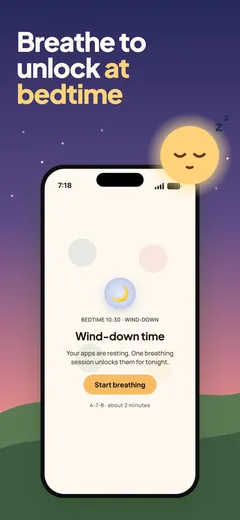
Steps 2 and 3 are what Evening Wind-Down does in Dawnova (our app). From 30, 60 or 90 minutes before your bedtime, the apps you pick are paused. One guided breathing session of about two minutes, such as 4-7-8 breathing, opens them again, which turns “one more scroll” into a calm pause first. See the Evening Wind-Down help article for setup; it’s part of Dawnova Pro (see plans).
How do you keep your phone out of the bedroom?
Keep your phone out of the bedroom by giving each of its night jobs to something else first. Most people try the no-phone-in-the-bedroom rule, then bring the phone back within a week because they need an alarm or something to fall asleep to. Replace those jobs and the rule holds without effort.
| The phone’s night job | Its replacement |
|---|---|
| Alarm | A basic alarm clock or sunrise clock |
| “What time is it?” at 3am | The same clock, with a dim display |
| White noise or sleep sounds | A fan, a white-noise machine or a speaker with a sleep timer |
| Reading in bed | A paper book, or an e-reader without a backlit screen |
| Podcasts and audiobooks | A smart speaker or old MP3 player with a timer |
| Torch to find the bathroom | A plug-in night light or a dim bedside lamp |
| Being reachable in an emergency | The phone just outside the door, with calls from favourites allowed to ring through |
If you share a room, agree the rule together and charge both phones in the same place. The rule also helps the other end of the day: when the phone isn’t on the nightstand, it isn’t the first thing you grab. Our guide on how to stop checking your phone in the morning picks up from there.
Why it sticks. The rule doesn’t ask you to resist the phone in bed. It removes the reasons the phone was there. A clock tells the time, a speaker plays the rain sounds, and the phone charges in the hall. Distance does the work that willpower can’t at midnight.
What can you do before bed instead of your phone?
Before bed, pick calm activities that have a natural end and don’t need a screen. The Sleep Foundation’s bedtime routine guide suggests reading, gentle stretching, a warm bath, breathing exercises, calming music and journaling. Choose two or three you enjoy and do them in the same order every night.
- Read a paper book under a warm, dim lamp. Fiction with an easy plot works best.
- Take a warm shower or bath. The Sleep Foundation suggests a bath at least an hour before sleep.
- Write a short to-do list for tomorrow. In a 2018 sleep-lab study of 57 young adults, 5 minutes writing a specific to-do list at bedtime led to falling asleep faster than writing about completed tasks.
- Do slow breathing. A few rounds of 4-7-8 take about two minutes; the breathing help article shows the guided version.
- Stretch for five minutes: neck, hips, hamstrings, nothing strenuous.
- Lay out tomorrow: clothes, bag, a glass of water for the morning.
- Listen to music or a podcast through a speaker, with the phone in the other room.
- Talk with a partner or housemate, or call someone before your wind-down starts.
- Do a puzzle: a crossword, sudoku or jigsaw on paper.
- Journal three lines about the day.
- Tidy one small thing: the kitchen counter, tomorrow’s lunch.
- Note how you slept each morning so you can see what helps; the sleep diary help article explains how to log it.
What if you use your phone to fall asleep?
If you use your phone to fall asleep, keep the audio and lose the screen. Sleep stories, rain sounds and podcasts work just as well from a speaker or a cheap MP3 player with a sleep timer. The screen is what tempts you into one more check, so moving the sound to another device removes the temptation and keeps the habit.
If the phone has to stay, set it up so it can only play: Sleep Focus or Bedtime mode on, notifications silenced, grayscale on, screen face down across the room, and a sleep timer on the audio app. It isn’t as strong as a phone-free bedroom, but it’s a solid first week while you buy a speaker. For the scrolling habit itself, our guide on how to stop doomscrolling goes further.
Frequently asked questions
How long before bed should I stop using my phone?
A common target is an hour. The Sleep Foundation suggests putting electronics away at the start of a 30-to-60-minute bedtime routine, and a 2022 expert consensus recommends keeping evening light low for at least 3 hours before sleep. If an hour feels hard, start at 30 minutes and move it earlier each week.
Is night mode or a blue light filter enough?
It’s a good start, but it only covers part of the picture. Night Shift and similar filters warm the screen colour, while the content itself keeps you scrolling and alert. Pair a filter with dimmer room lights, a wind-down time and a phone that charges outside the bedroom.
Why should I keep my phone out of the bedroom?
Because distance removes the choice. If the phone is on the nightstand, every wake-up and every “can’t sleep” moment ends with the screen. The Sleep Foundation suggests removing electronic devices from the bedroom, and doing so also stops the phone being the first thing you touch in the morning.
What can I use instead of my phone as an alarm?
A basic alarm clock is enough. A sunrise alarm clock that brightens gradually before it rings is a pleasant upgrade. Either one means you don’t need the phone within reach overnight, which is the step that makes a phone-free bedroom stick.
Can an app help me stop using my phone at night?
Yes. Built-in tools such as Downtime on iPhone and Bedtime mode on Android schedule the evening for you. Dawnova’s Evening Wind-Down pauses the apps you pick before bedtime and opens them after one guided breathing session, so stopping becomes a calm pause instead of a decision.
Sources
- Exelmans L, Van den Bulck J. Bedtime mobile phone use and sleep in adults. Social Science & Medicine, 2016.
- Chang AM, Aeschbach D, Duffy JF, Czeisler CA. Evening use of light-emitting eReaders negatively affects sleep, circadian timing, and next-morning alertness. PNAS, 2015.
- Brown TM, Brainard GC, Cajochen C, et al. Recommendations for daytime, evening, and nighttime indoor light exposure to best support physiology, sleep, and wakefulness in healthy adults. PLOS Biology, 2022.
- Watson NF, et al. Recommended amount of sleep for a healthy adult. Journal of Clinical Sleep Medicine, 2015.
- Scullin MK, Krueger ML, Ballard HK, et al. The effects of bedtime writing on difficulty falling asleep. Journal of Experimental Psychology: General, 2018.
- Sleep Foundation, How Electronics Affect Sleep.
- Sleep Foundation, How to Build a Better Bedtime Routine for Adults.
This article is general information, not medical advice. Dawnova is a wellness tool, not a medical device. If you have ongoing sleep problems, bipolar disorder or an eye condition, talk to a clinician before using bright-light routines.
Written by the Dawnova team. We build Dawnova, an app blocker whose Evening Wind-Down pauses your scrolling apps before bed until one guided breathing session. Research and settings checked in November 2026. Spotted something out of date? Tell us.