A morning routine without your phone is a short, fixed sequence you run before you unlock anything: water, light, movement, food, then a plan for the day. It works best with a separate alarm clock and the phone charging in another room. Below are three ready-made versions for 10, 25 and 45 minutes, and a swap for every job your phone used to do.
Key takeaways
- The core rule is order, not length: the phone goes last, after water, light and movement.
- Getting outside early gives you far more light than a bedroom; a 2022 expert consensus recommends at least 250 lux (melanopic EDI) at the eye during the day, even indoors.
- People whose notifications came in three batches a day felt more attentive and less stressed in a randomized field experiment of 237 people.
- A “dopamine morning routine” works best as a habit plan: put enjoyable things first and save the feed for later.
- New daily habits took a median of 66 days to feel automatic in a University College London study, and a missed day didn’t undo progress.
In this guide
- What does a morning routine without your phone look like?
- Why should your phone come last in the morning?
- Three phone-free morning routines: 10, 25 and 45 minutes
- What is a dopamine morning routine?
- How do you replace what your phone did in the morning?
- How do you make a phone-free morning stick?
- FAQ
What does a morning routine without your phone look like?
A morning routine without your phone has five building blocks in a set order: wake (to a clock), hydrate, get light, move, then eat or plan. The phone comes after the last block, at a time you choose. Each block can take one minute or twenty, which is why the same routine scales from a rushed weekday to a slow Sunday.
The order matters more than the length. Water and light come first because they’re quick and they get you out of bed. Movement follows because it’s easiest once you’re up. The phone goes last because once it’s unlocked, the rest of the routine tends to disappear into it. Our guide on how to stop checking your phone in the morning covers the setup that keeps the phone out of reach while you do this.
Why should your phone come last in the morning?
Your phone should come last because the first half hour sets the day’s pace, and the phone hands that half hour to other people’s messages and feeds. Putting it last means you start with light, movement and your own plan, then check in on purpose. The research on attention and light supports the order.
- Attention. In a randomized field experiment of 237 people (Fitz and colleagues, 2019), those whose notifications were batched three times a day felt more attentive, productive and in control, and reported lower stress than those getting notifications as usual. A phone-free first hour is a natural first batch.
- Light. A 2022 expert consensus in PLOS Biology recommends at least 250 lux (melanopic EDI) at the eye during the day. Daylight outdoors is usually far brighter than that, which is why the Sleep Foundation recommends getting light early in the day to support your body clock.
- Habit. In a 2018 Pew Research Center survey, 44% of US teens and 26% of parents said they often check for messages as soon as they wake up. A routine that runs first gives that habit something else to do.
Three phone-free morning routines: 10, 25 and 45 minutes
Choose the plan that fits a normal weekday, not your best day. Each one uses the same order, so you can switch between them without learning anything new. Set out what you need the night before: a glass of water, clothes, shoes and a paper card with tomorrow’s top three tasks.
| Block | 10 minutes | 25 minutes | 45 minutes |
|---|---|---|---|
| Wake | Alarm clock, sit up | Alarm clock, sit up, open curtains | Alarm clock, open curtains, make the bed |
| Hydrate | Glass of water | Water, then put the kettle on | Water, then coffee or tea |
| Light | 3 minutes on a doorstep or balcony | 10-minute walk outside | 20-minute walk or coffee outdoors |
| Move | 10 squats or a 1-minute stretch | 5 minutes of stretching | 15 minutes of yoga, a run or a workout |
| Eat or plan | Read your top-three card | Breakfast at the table | Breakfast, then 5 minutes journaling |
| Phone | Unlock | Unlock | Unlock |
The 10-minute routine
For rushed mornings. Alarm clock off, sit up, drink the water you left out, step outside for a few minutes, do a quick stretch, read your card. Only then pick up the phone. It’s short enough that you’ll do it on your worst day, which is what keeps the chain going.
The 25-minute routine
For most weekdays. The walk is the anchor: ten minutes outside gets you light and movement at once. Put the kettle on before you leave so breakfast is waiting. On a grey morning the walk still counts; our post on morning sunlight on cloudy days explains why overcast daylight is still far brighter than indoors.
The 45-minute routine
For slow mornings and weekends. Add real exercise, a sit-down breakfast and a few minutes of journaling. If you want this every day, build up to it from the 25-minute plan rather than starting here.
What is a dopamine morning routine?
A dopamine morning routine is a popular name for a morning that starts with things you enjoy that aren’t screens, such as coffee outside, music or a walk, and saves the scrolling for later. The useful idea is about habits, not brain chemistry: make the start of the day rewarding enough that you don’t miss the feed.
Three habit tricks make it work:
- Pair the pleasant with the useful. Behavioural scientists call this temptation bundling. In a 2014 field experiment, people who could only hear their favourite audiobooks at the gym initially went to the gym 51% more often than a control group. In the morning: your best coffee, but only on the balcony; your favourite album, but only on the walk.
- Put a small win early. A made bed or a finished stretch is a visible, quick finish to start the day on.
- Give the phone a time, not a ban. “After breakfast” is a reward to look forward to, not a rule to fight.
If you’ve read about dopamine detoxes, our post on the dopamine detox for phone addiction explains what the trend gets right and how to use it as a 7-day plan.
How do you replace what your phone did in the morning?
Replace each morning job your phone did with a single-purpose alternative, then the phone has no reason to be in your hand. Most people use the phone for five or six things before breakfast. Swap each one once, and the phone-free routine runs without you having to resist anything.
| Phone job | Phone-free swap |
|---|---|
| Alarm | An alarm clock or sunrise clock |
| Weather | Look outside, or check it the night before |
| News and messages | A set check-in time after the routine |
| Calendar and to-dos | A paper card written the night before |
| Music or podcast | A speaker in the kitchen |
| Workout timer | A kitchen timer or a watch |
If you need the phone for something specific, like a two-factor code or a call, block only the apps that pull you in. On iPhone, Scheduled Summary (Settings > Notifications > Scheduled Summary) can hold most notifications until after your routine.
How do you make a phone-free morning stick?
Make it stick by deciding the trigger and the finish line in advance, and by expecting it to take about two months. Write it as an “if, then” plan: “When the alarm clock rings, I drink the water, then I go outside.” A clear end point such as “after breakfast” tells you when the phone is allowed.
Both parts have research behind them. Planning “if, then” rules like this, called implementation intentions, had a medium-to-large effect on reaching goals in a meta-analysis of 94 tests. And in a University College London study (Lally and colleagues, 2010), new daily habits took a median of 66 days to feel automatic, ranging from 18 to 254 days, and missing one day didn’t meaningfully set people back.
The last piece is making the finish line real. Dawnova (our app) does that with Morning Focus: the apps you pick stay closed after you wake until you walk 15 steps and snap a photo of the sky, which Sunny checks is the real sky. That makes the “light” block of your routine the way back into your apps. On dark winter mornings, a photo of your lamp counts instead. Setup is in the Morning Focus help article; it’s part of Dawnova Pro (see plans), and your first morning is free.
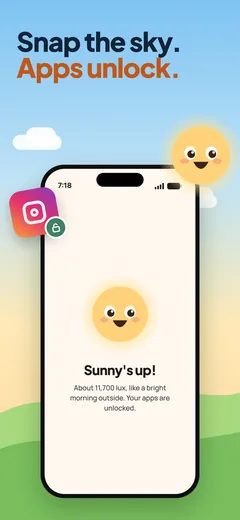
Dawnova’s light sessions, free in the app, then time your daylight to your local sunrise and the weather: about 3 minutes in bright sun and around 10 on a grey winter day. Each one adds to your streak.
Why it sticks. A phone-free morning lasts when the routine and the reward are the same thing. You walk, you get light, you snap the sky, and the apps open. There’s no rule to argue with at 7am, just the next step, and by the time you scroll you’ve already had a good start.
Mornings start the night before. If evenings are the hard part, read how to stop using your phone before bed next.
Frequently asked questions
How long should I go without my phone in the morning?
Long enough to finish your routine, whether that’s 10 minutes or an hour. A step-based finish line (after the walk, after breakfast) works better than a clock time, because it guarantees you’ve had water, light and some movement before the phone gets your attention.
What should I do first thing in the morning instead of my phone?
Drink a glass of water, open the curtains and get outside for a few minutes. Those three steps take under ten minutes, get you out of bed and give you daylight early. After that, stretch or move, eat, and look at a short plan for the day before you unlock the phone.
Is a dopamine morning routine backed by science?
The name is a trend, but the habit ideas behind it are well studied. Pairing something enjoyable with something useful (temptation bundling) and planning “if, then” routines (implementation intentions) both helped people follow through in research. Use it as a habit plan, not a brain-chemistry plan.
What if I need my phone for work first thing?
Keep the tools you need and block the rest. Calls, messages, your authenticator and email can stay open while social and video apps wait until your routine is done. Scheduled Summary on iPhone or Bedtime mode on Android can also hold most notifications until a set time.
Can I listen to music or podcasts on a phone-free morning?
Yes. Play them through a speaker so the phone stays out of your hand, or start a podcast once you’re outside and your routine’s light block is done. The aim is to keep the screen out of the first part of the morning, not to give up audio.
Sources
- Fitz N, Kushlev K, Jagannathan R, et al. Batching smartphone notifications can improve well-being. Computers in Human Behavior, 2019.
- Brown TM, Brainard GC, Cajochen C, et al. Recommendations for daytime, evening, and nighttime indoor light exposure to best support physiology, sleep, and wakefulness in healthy adults. PLOS Biology, 2022.
- Pew Research Center, How Teens and Parents Navigate Screen Time and Device Distractions, 2018.
- Milkman KL, Minson JA, Volpp KGM. Holding the Hunger Games hostage at the gym: an evaluation of temptation bundling. Management Science, 2014.
- Gollwitzer PM, Sheeran P. Implementation intentions and goal achievement: a meta-analysis of effects and processes. Advances in Experimental Social Psychology, 2006.
- Lally P, van Jaarsveld CHM, Potts HWW, Wardle J. How are habits formed: modelling habit formation in the real world. European Journal of Social Psychology, 2010.
- Sleep Foundation, Light and Sleep.
This article is general information, not medical advice. Dawnova is a wellness tool, not a medical device. If you have ongoing sleep problems, bipolar disorder or an eye condition, talk to a clinician before using bright-light routines.
Written by the Dawnova team. We build Dawnova, an app blocker that keeps your scrolling apps closed each morning until you’ve walked 15 steps and snapped the sky, and we run phone-free mornings ourselves. Research checked in November 2026. Spotted something out of date? Tell us.